nlmixr2 7.0’s covariance step, all grown up

Watch on YouTube In the 7.0 post, I talked mostly about parallel solving in focei. This time I want to talk about a feature that has been requested frequently: a full covariance step, and other refinements to the covariance steps. Two things changed there, and they are related: Nearly any covariance method can now be requested from nearly any estimation method, and you can switch a finished fit to a different one without refitting.

By Matthew Fidler in nlmixr2

August 17, 2026

Tiny Doses for Tiny Babies – How much is too much?

Preterm infants are highly susceptible to seizures primarily due to brain immaturity and an increased vulnerability to acute brain injuries and systemic imbalances, so if an infant is delivered pre-term they may be likely to have seizures. So, with a preterm infant with seizures – what can we do in data analytics to support the right drug and dose the first time? As stated by Paracelsus, the dose makes the poison: Too little and the seizures continue, too much and the infant stops breathing.

By Matthew Fidler & Janice Goh in nlmixr2

August 11, 2026

nlmixr2 7.0

Watch on YouTube nlmixr2 7.0 This is the release where focei finally solves in parallel on all OpenMP-enabled platforms. Along with that, a few defaults changed, which means that by default focei will not give you the same numbers it gave you in nlmixr2 6. This is a deliberate change and we will talk about the motivation in this post (and how to get the old behavior back if you need it).

By Matthew Fidler in nlmixr2

August 5, 2026

Fitting PK/PD models to published data with admixr2

Usually, pharmacometric modelling starts with a dataset with individual patient data: one row per observation, in a software-ready format. To model these data, you would first need to get access to the data, which means data-sharing agreements, trial access, or in-house studies. This process is often slow or even not possible due to privacy or competition. However, researchers do publish their model and sometimes summary metrics. The published reports do contain useful information.

By H. van de Beek in nlmixr2

July 2, 2026

Survival Analysis with nlmixr2

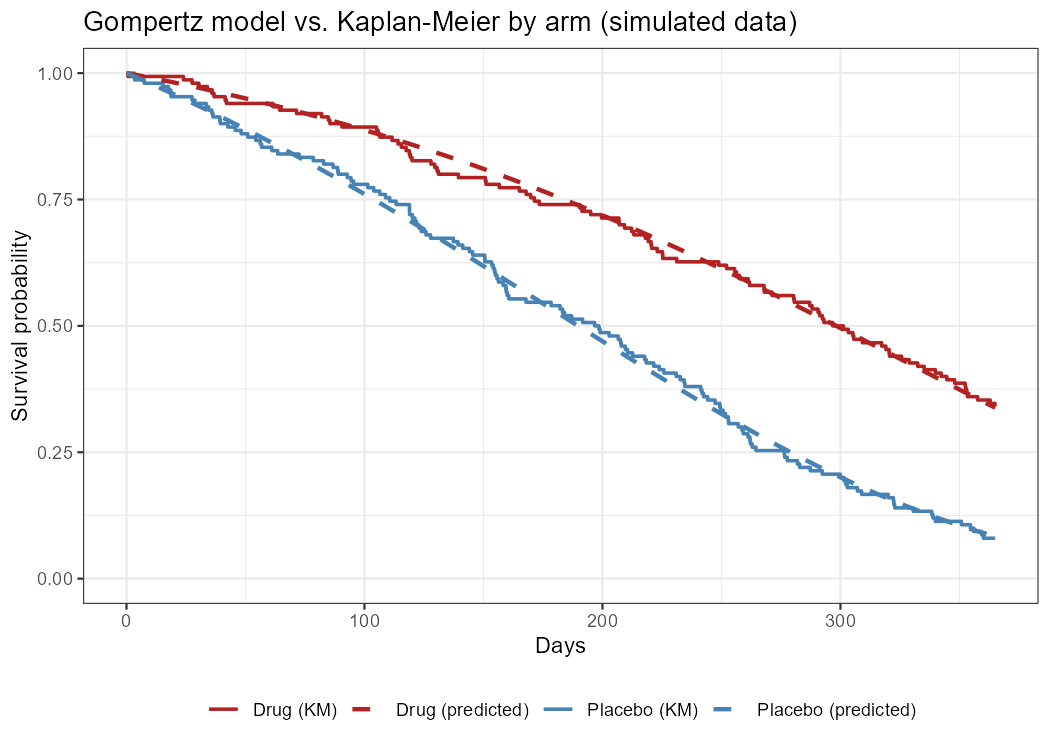
Introduction Survival or time-to-event (TTE) analysis models when something happens, not just whether it happens. The endpoint might be time to tumour progression, time to an adverse event, or time to treatment discontinuation, for instance. In this post we’ll illustrate how to fit parametric TTE models in nlmixr2 using its custom log-likelihood interface. For the purposes of this post, we’re going to simulate a two-arm randomised trial from a known Gompertz model, then recover the parameters with nlmixr2.

By Justin Wilkins and the nlmixr2 Development Team in nlmixr2

May 28, 2026